Heritage documentation · November 2026
Heritage damage in South Lebanon, 2024–2026
What these villages once held, what the wars have destroyed and what can still be saved
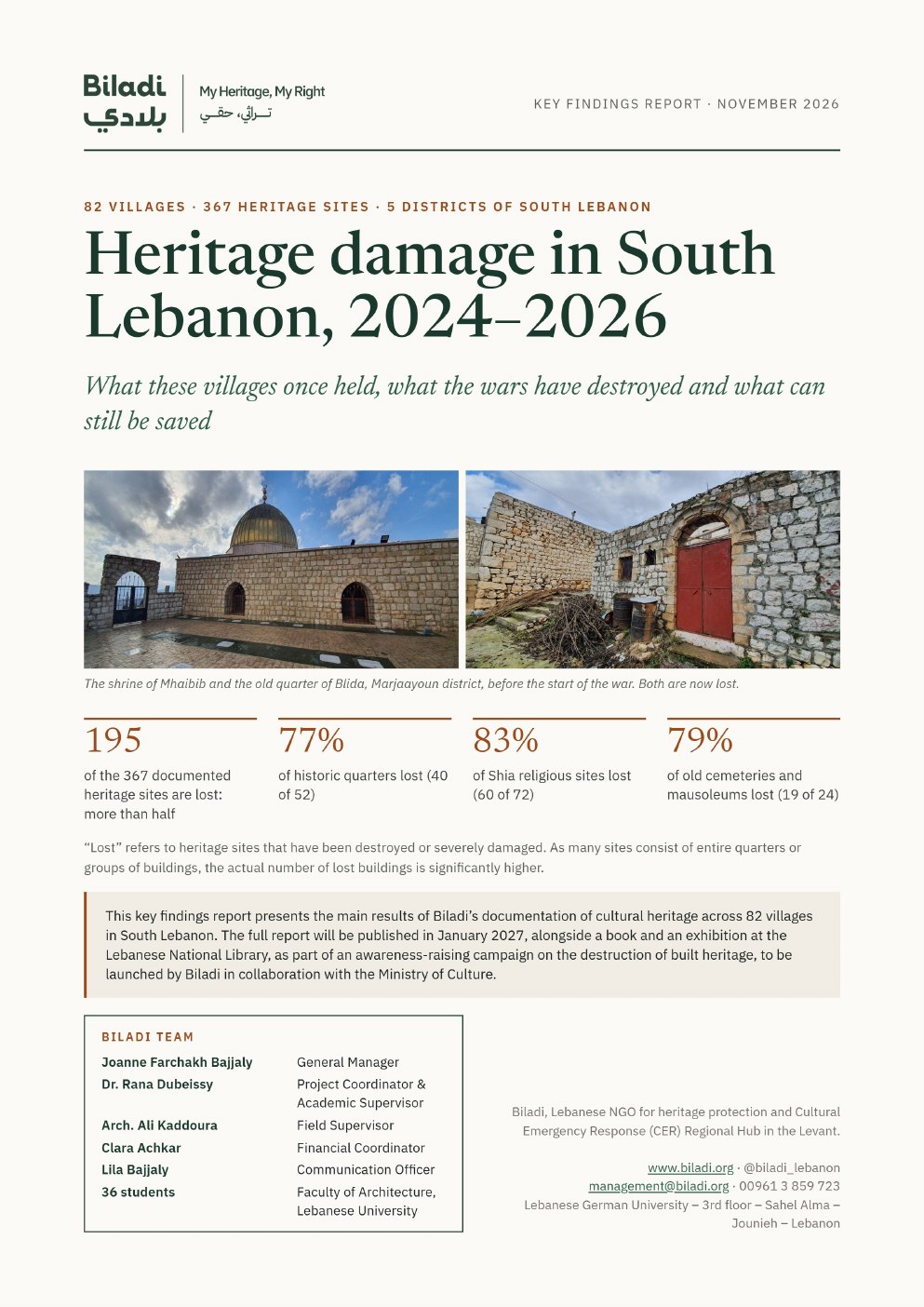
The shrine of Mhaibib and the old quarter of Blida, Marjaayoun district, before the war. Both are now lost. Original photographs from Biladi’s report.
A record of loss.
A foundation for recovery.
Biladi began documenting South Lebanon’s heritage in October 2023. A team of 36 architecture students and recent graduates from the Lebanese University mapped 82 villages in five districts: Bint Jbeil, Marjaayoun, Tyre, Nabatieh and Hasbaya. They documented 367 heritage sites in 66 villages. Of these, 195 are destroyed or severely damaged (53%): 87 lost in 2024 and another 108 in 2026. Only 20% remain in use, compared with 76% before 2024.
“Lost” means destroyed or severely damaged. A site may be a whole historic quarter or group of buildings; building losses are higher than site counts.
What the record reveals
How the record was made
Every site has its own coded file, recording its location, history, role in village life and condition before and after each war. Field visits in 2025 photographed and described historic buildings. With most villages unreachable in 2026, displaced residents shared photographs and memories; destruction was checked through media reports, satellite imagery and residents’ testimonies. The team gathered more than 1,400 photographs for the 2026 files and cross-checked 340 site files against books, articles and other sources. Local experts and journalists reviewed the data. The 2026 conditions will be confirmed on the ground once access is restored; status remains unknown for 9 sites. This report covers the 82-village mapping; a separate report will present the building-level study of five Nabatieh localities.
The record belongs to the people of the South.
Displaced residents shared their photographs, their memories and the names of the places they lost. In the 20 villages where nothing survived, the record is now the memory. Biladi’s next task is to give it back.
The full report and a book will be published in January 2027. An exhibition will open at the Lebanese National Library and Beit Beirut, then travel to other cities, including in the South, with permanent and mobile parts designed by the students. Under the memorandum signed with the Ministry of Culture on 19 October 2026, Biladi will share the data for State reconstruction plans and advocate for the protection of the 73 sites still in use and 90 damaged or deteriorated sites still standing. A website with an interactive map of about 400 geolocated monuments is planned in a second phase, to March 2027, alongside gatherings with communities and displaced families.
Read and share the English reportالأضرار التي لحقت بالتراث في جنوب لبنان، 2024–2026